
Rock Cotoneaster
Cotoneaster horizontalis 'Perpusillus'
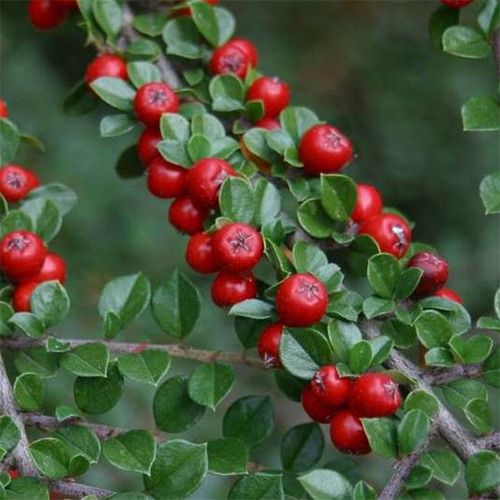
Rock Cotoneaster
Cotoneaster horizontalis 'Perpusillus'
Cotoneaster horizontalis ‘Perpusillus’, commonly known as Dwarf Rockspray Cotoneaster, is a low growing, spreading shrub that brings fine texture and strong seasonal interest into the landscape. It’s especially useful for groundcover applications and softening hard edges.
The foliage is small, rounded, and neatly arranged along horizontal branching stems that create a distinctive layered, almost herringbone pattern. The structure alone adds a subtle architectural quality even when not in bloom.
In spring, it produces small, pale pink to white flowers that are modest but attractive up close. These are followed by bright red berries in fall, which create a striking contrast against the foliage and can persist into winter.
The leaves may also take on warm red to orange tones in cooler seasons, adding another layer of seasonal color.
It has a low, spreading habit, making it ideal for slopes, walls, borders, or as a dense groundcover.
Cotoneaster ‘Perpusillus’ grows best in full sun to partial shade and prefers well drained soil. Once established, it is fairly drought tolerant and adaptable.
It typically stays around 1 to 2 feet tall and can spread 4 to 6 feet wide, forming a wide, low mat. It is well suited for USDA zones 5 through 9, however it is also seen thriving here in Southern California which is why we have included zone 10. The foliage is semi evergreen depending on climate.
This plant has low toxicity, though the berries should not be consumed.
The flowers attract pollinators such as bees, and the berries may attract birds.
It is generally deer resistant.
Cotoneaster horizontalis ‘Perpusillus’ fits especially well into Mediterranean, hillside, and naturalistic garden designs, where it can be used to stabilize slopes and create layered groundcover.
It pairs well with plants like Juniperus horizontalis to reinforce a low, spreading structure, Festuca glauca to add cool toned contrast, and Achillea tomentosa to introduce a soft, flowering ground layer.
Expert Tip:
Place this where it has room to spread, because its horizontal branching creates the most impact when allowed to develop naturally. Occasional thinning will help maintain its layered structure and prevent overcrowding.
— Nick from Rooted Theory
Proper planting technique will help your plants thrive! Follow these simple steps to help your plants establish quickly, develop a strong root system, and live longer:
- Properly dig the hole
- Amend the soil to suit each particular plant
- Place the plant and backfill the soil
- Provide ample water for each particular plant
- Review our how to plant guide!
For detailed information, please download our planting guides: