
Lily of the Nile
Agapanthus orientalis
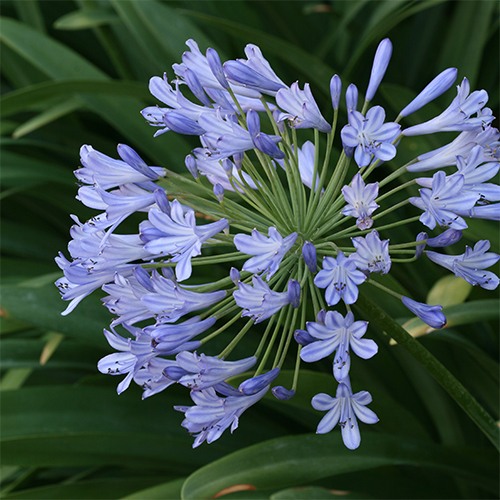

Lily of the Nile
Agapanthus orientalis
Agapanthus orientalis, commonly known as Lily of the Nile, is a reliable, clumping perennial that brings structure and seasonal color into the landscape. It’s widely used for its clean foliage and bold flower display.
The leaves are long, strap like, and deep green, forming a dense, upright clump that works well as a base layer in planting designs. Even when it’s not in bloom, the foliage has a strong, architectural presence.
In late spring through summer, tall flower stalks rise above the foliage and are topped with rounded clusters of blue to violet blooms. When planted in groups, the flowers create a repeating rhythm that carries through the landscape.
It’s a very versatile plant that works well in borders, mass plantings, along driveways, or as a clean edging plant. It can also be used to soften walls and fences without taking up too much space.
Agapanthus orientalis grows best in full sun to partial shade and prefers well drained soil. Once established, it is fairly drought tolerant, though it will perform best with occasional watering.
It typically grows about 2 to 3 feet tall at the foliage, with flower stalks reaching 3 to 4 feet or more. It is well suited for USDA zones 8 through 11 and performs well in warm climates. The foliage is evergreen in mild conditions.
This plant has some toxicity and may cause irritation or illness if ingested, so it is best to plant with care around pets and children.
The flowers attract pollinators such as bees.
It is generally deer resistant, though occasional browsing may occur.
Agapanthus orientalis fits especially well into Mediterranean, coastal, and formal garden designs, where its structure and repeatable form can be used to create rhythm and cohesion.
Expert Tip:
I like using this in repetition along walkways or driveways to create a clean, consistent line. planting these in masses creates a strong visual dynamic, and the blooms help carry that rhythm through the space when they’re in season. People often disregard it because it may be considered generic, but it's a easy care, low frustration plant that consistently performs.
— Nick from Rooted Theory
Proper planting technique will help your plants thrive! Follow these simple steps to help your plants establish quickly, develop a strong root system, and live longer:
- Properly dig the hole
- Amend the soil to suit each particular plant
- Place the plant and backfill the soil
- Provide ample water for each particular plant
- Review our how to plant guide!
For detailed information, please download our planting guides: