
Tropical Milkweed
Asclepias curassavica
Tropical Milkweed
Asclepias curassavica
Asclepias curassavica, commonly known as Tropical Milkweed, is a vibrant, fast growing perennial that brings bold color and strong ecological value into the landscape. It’s especially known for supporting monarch butterflies and other pollinators.
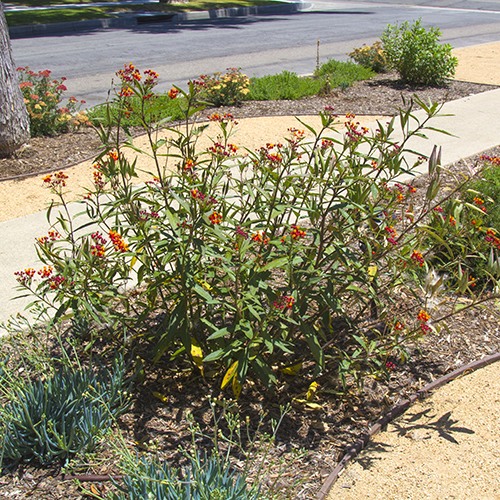
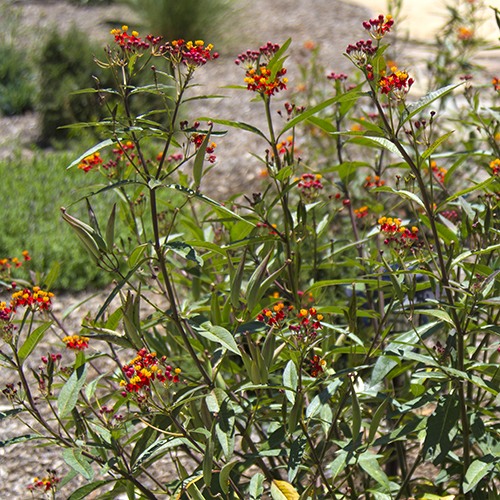
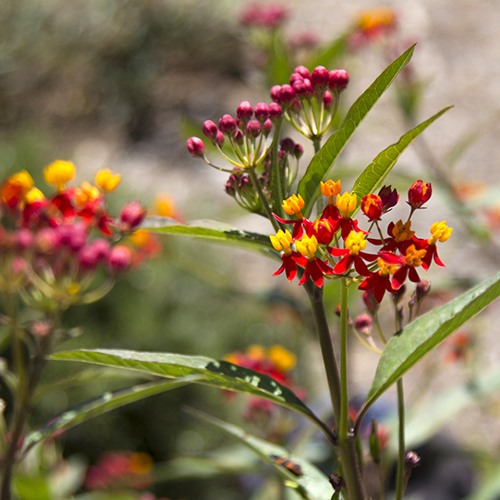
The foliage is narrow, lance-shaped, and bright green, forming an upright, lightly structured plant. It provides a clean backdrop that allows the flowers to stand out clearly.
From spring through fall, it produces clusters of striking red and orange flowers with yellow accents. The blooms are vivid and continuous, creating a strong visual presence while also serving as an important nectar source.
It has an upright, somewhat open growth habit, making it ideal for borders, pollinator gardens, or as a seasonal accent in mixed plantings.
Asclepias curassavica grows best in full sun and prefers well drained soil. It benefits from regular watering but can tolerate some dry conditions once established.
It typically reaches about 3 to 4 feet tall and 2 to 3 feet wide, forming a vertical, flowering presence. It is well suited for USDA zones 8 through 11. The foliage is evergreen in warm climates.
This plant has moderate toxicity if ingested, and its milky sap can be irritating, so care should be taken when handling.
The flowers are highly attractive to pollinators, especially monarch butterflies, serving as both a nectar source and host plant for caterpillars.
It may reseed in favorable conditions, allowing it to naturalize in the garden.
It is generally deer resistant.
Asclepias curassavica fits especially well into pollinator, cottage, and Mediterranean garden designs, where it can be used to support wildlife and add long-lasting color.
It pairs well with plants like Verbena lilacina ‘De La Mina’ to extend pollinator activity, Gaura lindheimeri to introduce movement and a lighter texture, and Salvia guaranitica ‘Black and Blue’ to add contrasting color and vertical interest.
Expert Tip:
Place this in full sun and allow it some room to reseed, because it can naturalize and create a more dynamic, pollinator-friendly planting over time. Cutting it back occasionally will help refresh growth and maintain a tidy appearance.
— Nick from Rooted Theory
Proper planting technique will help your plants thrive! Follow these simple steps to help your plants establish quickly, develop a strong root system, and live longer:
- Properly dig the hole
- Amend the soil to suit each particular plant
- Place the plant and backfill the soil
- Provide ample water for each particular plant
- Review our how to plant guide!
For detailed information, please download our planting guides: