
Camphor Tree
Cinnamomum camphora - Single Trunk
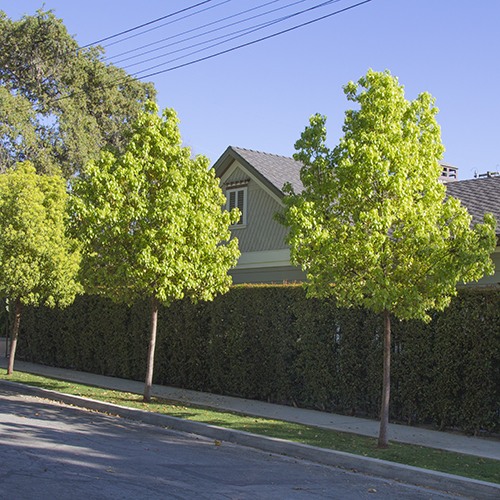

Camphor Tree
Cinnamomum camphora - Single Trunk
Cinnamomum camphora, commonly known as Camphor Tree, is a large, evergreen shade tree that brings a strong, established presence into the landscape. In single trunk form, it has a more traditional tree structure with a defined canopy and a clean vertical form.
The foliage is glossy, bright to deep green, with a slightly aromatic quality when crushed. The leaves form a dense canopy that provides excellent shade, making it a great option for larger spaces where coverage is needed.
As the tree matures, the branching structure becomes more prominent, with a broad, spreading canopy that creates a classic shade tree silhouette. It’s often used in parks, large residential landscapes, or as a long term anchor tree.
In spring, it may produce small, inconspicuous flowers followed by dark berries, though it is primarily valued for its foliage and shade.
Cinnamomum camphora grows best in full sun to partial shade and prefers well drained soil. Once established, it is fairly drought tolerant and adapts well to a variety of conditions.
It can grow quite large over time, often reaching 30 to 50 feet tall and wide or more, forming a broad, dense canopy. It is well suited for USDA zones 8 through 11. The foliage is evergreen.
This plant has low toxicity, though the leaves and berries should not be consumed in large quantities.
The flowers may attract pollinators such as bees, and the berries can attract birds.
It is generally deer resistant.
Cinnamomum camphora fits especially well into Mediterranean, park style, and large scale residential designs, where it can be used for shade, structure, and long term canopy.
It pairs well with plants like Ligustrum japonica ‘Texanum’ for layered screening, Agapanthus orientalis to create a clean, repeatable base layer, and Myoporum parvifolium ‘Putah Creek’ to cover larger areas beneath the canopy.
Expert Tip:
I like to think long term with this tree. It grows into a large canopy, so giving it enough space from the start is key. Establishing a strong central structure early on with selective pruning helps it develop into a much cleaner, more balanced shade tree over time. Don't plant close to your driveway!
— Nick from Rooted Theory
Proper planting technique will help your plants thrive! Follow these simple steps to help your plants establish quickly, develop a strong root system, and live longer:
- Properly dig the hole
- Amend the soil to suit each particular plant
- Place the plant and backfill the soil
- Provide ample water for each particular plant
- Review our how to plant guide!
For detailed information, please download our planting guides: