
Aloe Vera
Aloe barbadensis
Aloe Vera
Aloe barbadensis
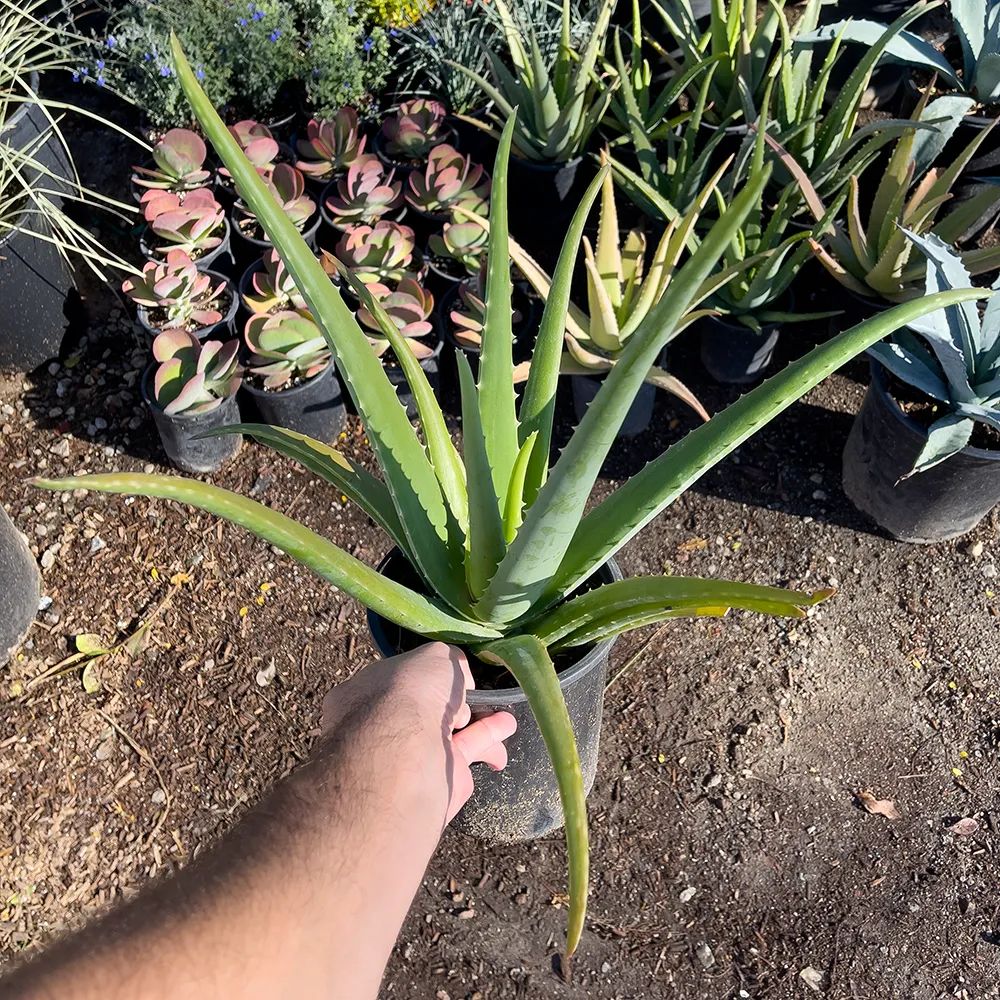
Aloe barbadensis, commonly known as Aloe Vera, is a classic succulent valued for both its clean, sculptural form and its practical uses. It’s one of those plants that works just as well in the landscape as it does in containers.
The foliage forms thick, fleshy leaves in a soft green to gray green tone, arranged in a symmetrical rosette. The leaves have subtle serrations along the edges but are generally not overly aggressive, making them easier to work with than many other succulents.
Over time, it produces offsets around the base, forming small clusters that can be divided or allowed to spread naturally. This makes it a great option for filling in space or creating a cohesive grouping.
In late winter to spring, mature plants send up tall flower stalks with tubular yellow blooms that rise above the foliage, adding a vertical accent and attracting pollinators.
Beyond its ornamental value, Aloe Vera is widely known for the gel inside its leaves, which is often used for soothing skin.
Aloe barbadensis grows best in full sun to partial shade and requires well drained soil. It is highly drought tolerant once established and performs well in warm, dry conditions.
It typically reaches about 1 to 2 feet tall and wide per rosette, with clusters spreading over time. It is well suited for USDA zones 9 through 11. The foliage is evergreen.
This plant has low to moderate toxicity if ingested, so it’s best to plant with care around pets and children.
The flowers attract pollinators such as bees and hummingbirds.
It is generally deer and rabbit resistant.
Aloe barbadensis fits especially well into Mediterranean, desert, and container garden designs, where its form and practicality make it a versatile choice.
It pairs well with plants like Crassula ovata ‘Gollum’ to add a sculptural companion, Senecio mandraliscae to introduce a cool, blue ground layer, and Kalanchoe luciae (Flapjack) to bring in bold, contrasting foliage shapes.
Expert Tip:
Place this in well drained soil and avoid overwatering, because excess moisture is the most common cause of decline. Allowing the soil to dry between watering will keep the plant healthy and prevent root issues.
— Nick from Rooted Theory
Proper planting technique will help your plants thrive! Follow these simple steps to help your plants establish quickly, develop a strong root system, and live longer:
- Properly dig the hole
- Amend the soil to suit each particular plant
- Place the plant and backfill the soil
- Provide ample water for each particular plant
- Review our how to plant guide!
For detailed information, please download our planting guides: