
Dwarf Karo
Pittosporum crassifolium 'Nana'
Dwarf Karo
Pittosporum crassifolium 'Nana'
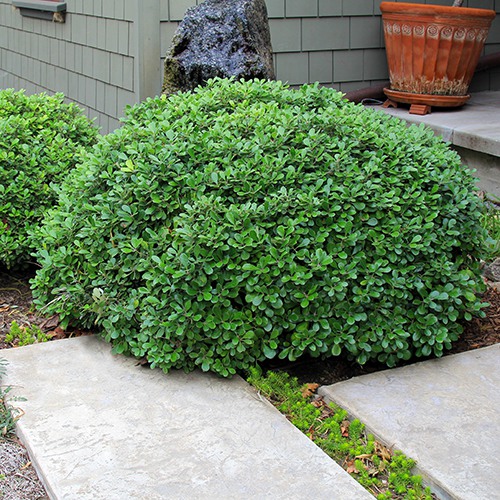
Pittosporum crassifolium ‘Nana’, commonly known as Dwarf Karo, is a compact, evergreen shrub that brings structure and soft contrast into the landscape. It’s a great option when you want a controlled, low growing plant with a slightly coastal, silvery look.
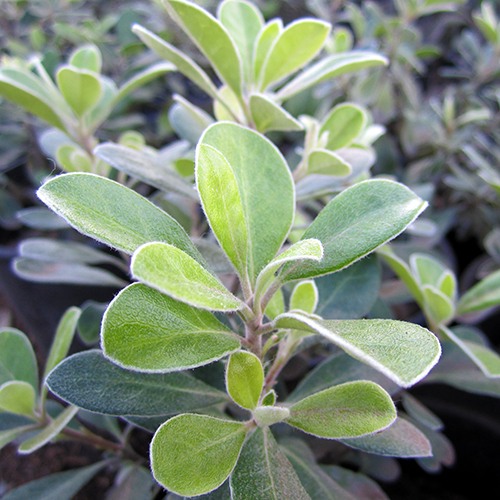
The foliage is small, rounded, and leathery, with a gray green to silvery tone that gives the plant a muted, refined appearance. The undersides of the leaves are lighter, adding subtle variation as they move in the wind.
It forms a dense, naturally rounded mound that stays compact with minimal pruning. This makes it ideal for low hedging, foundation planting, or as a filler that maintains a clean, consistent shape.
While it may produce small, dark flowers, they are not especially showy and the plant is primarily valued for its foliage and form.
Pittosporum ‘Nana’ grows best in full sun to partial shade and prefers well drained soil. Once established, it is drought tolerant and performs well in coastal and inland conditions.
It typically reaches about 2 to 3 feet tall and 3 to 4 feet wide, forming a tight, mounded shrub. It is well suited for USDA zones 9 through 11. The foliage is evergreen.
This plant has low toxicity and is generally safe for gardens with pets and children.
The flowers may attract pollinators such as bees, though they are not a primary feature.
It is generally deer resistant.
Pittosporum crassifolium ‘Nana’ fits especially well into Mediterranean, coastal, and modern garden designs, where its compact form and soft color can be used to create structure and cohesion.
It pairs well with plants like Leucadendron ‘Safari Sunset’ to introduce bold color and contrast, Lomandra ‘Breeze’ to add a fine-textured, flowing element, and Sedum reflexum ‘Blue Spruce’ to create a low, cool toned ground layer that complements the silvery foliage.
Expert Tip:
Place this where a compact, low structure is needed, because it naturally holds a dense, rounded shape with minimal maintenance. Occasional light pruning will help keep it tight and prevent it from becoming too open over time. A very underused plant in my opinion.
— Nick from Rooted Theory
Proper planting technique will help your plants thrive! Follow these simple steps to help your plants establish quickly, develop a strong root system, and live longer:
- Properly dig the hole
- Amend the soil to suit each particular plant
- Place the plant and backfill the soil
- Provide ample water for each particular plant
- Review our how to plant guide!
For detailed information, please download our planting guides: