
Golden Sword Yucca
Yucca filamentosa 'Golden Sword'
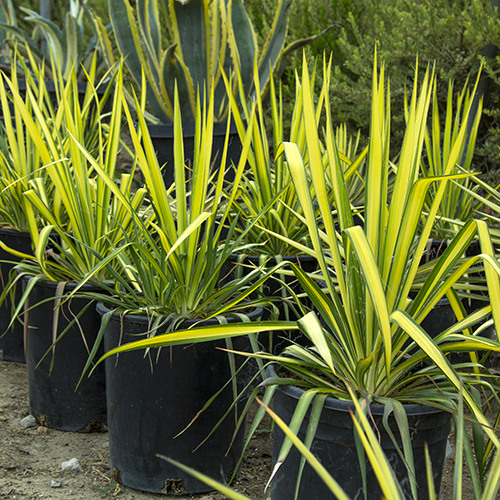
Golden Sword Yucca
Yucca filamentosa 'Golden Sword'
Dasylirion wheeleri, commonly known as Desert Spoon, is a bold, architectural plant that brings a strong structural element into the landscape. It’s often used as a focal point in dry gardens where form and texture are the main drivers.
The foliage forms a dense, spherical rosette made up of long, narrow, blue gray leaves. Each leaf has small serrated edges, giving it a slightly coarse texture up close, while from a distance it reads as a clean, sculptural form.
As it matures, it can develop a short trunk, which elevates the rosette and adds even more presence. In the right conditions, older plants may send up a tall, dramatic flower spike that can reach well above the foliage.
This is a slow growing plant, but it’s extremely durable and well suited for harsh conditions. It works well as a standalone specimen or grouped with other drought tolerant plants where you want strong contrast and definition.
Dasylirion wheeleri grows best in full sun and requires excellent drainage. Once established, it is highly drought tolerant and thrives in hot, dry environments.
It typically grows about 3 to 5 feet tall and wide at the rosette, with flower spikes reaching much higher. It is well suited for USDA zones 8 through 11 and can tolerate some cold, especially in dry conditions. The foliage is evergreen.
This plant has low toxicity, though the serrated leaf edges can be sharp, so placement should be considered in high traffic areas.
The flowers may attract pollinators such as bees.
It is generally deer and rabbit resistant, making it a dependable option for low maintenance plantings.
Dasylirion wheeleri fits especially well into desert, Mediterranean, and modern garden designs, where its form can be used as a focal point or structural anchor.
It pairs well with plants like Agave americana or Agave americana ‘Marginata’ for bold, complementary structure, Hesperaloe parviflora to add vertical movement and seasonal blooms, and Myoporum parvifolium ‘Putah Creek’ as a low groundcover to soften the base and tie the planting together.
Expert Tip:
I like giving this plant plenty of space so its natural shape can really come through. It’s easy to overcrowd something this sculptural, but when it stands on its own a bit, it has a much stronger impact in the design. It looks spectacular along a darker wood fence...gives some great contrast!
— Nick from Rooted Theory
Proper planting technique will help your plants thrive! Follow these simple steps to help your plants establish quickly, develop a strong root system, and live longer:
- Properly dig the hole
- Amend the soil to suit each particular plant
- Place the plant and backfill the soil
- Provide ample water for each particular plant
- Review our how to plant guide!
For detailed information, please download our planting guides: